This article contains affiliate links. As an Amazon Associate I earn from qualifying purchases.
My father spent a lot of time working on cars.
I was usually nearby.
I didn't learn anything.
He was under them mostly. I could tell he knew what he was doing. I had no idea what he was doing. There's a difference between being close to knowledge and actually absorbing it, and I spent most of my childhood on the wrong side of that gap.
He left before I got to high school. A few years later, my mom bought herself a new Honda Civic and handed down the family car: a 1995 Pontiac Bonneville SE. Fully leather. Smooth ride. The kind of car teenagers called a "boat," which was accurate and not an insult.
I was now the owner of a vehicle I understood almost nothing about.
I knew I was supposed to check the oil. That had stuck from watching him. So I'd push the dipstick in, pull it out, wipe it, push it back in, pull it out and read it. I don't know if that was exactly right. It worked, which was the main thing. Dark brown oil meant I was fine. Black oil meant I was probably overdue. I picked that up somewhere and it turned out to be correct.
The gas gauge was broken. I tracked mileage instead to estimate when I needed to fill up. That system worked until one day on the highway when the car just stopped responding to the gas pedal. Turns out the margin for error on "estimating" is not as generous as I had assumed.
I will also say: I have watched every Fast and Furious movie. Not one of them has a gas station scene. Nobody ever stops. I don't know what to make of that.
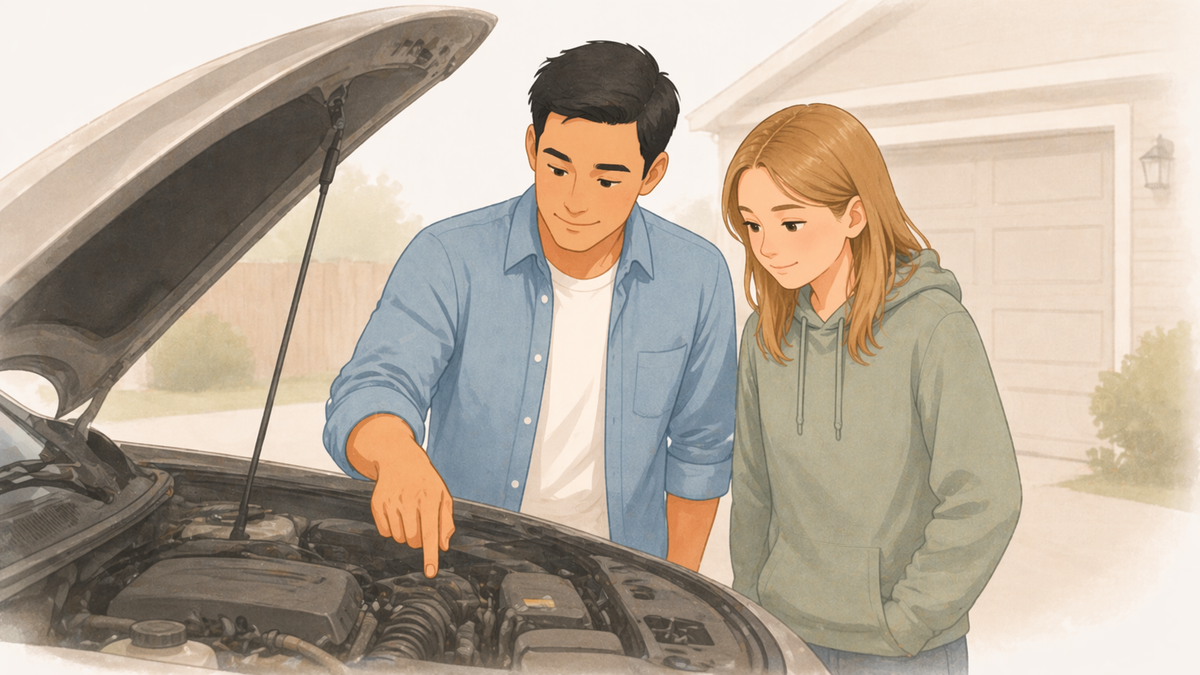
The point is that I figured out car basics the hard way, alone, with a Haynes manual that was genuinely overwhelming. The ten-minute version of that education exists. Nobody gave it to me. I'm giving it to my daughter before she needs it.
She doesn't have a car yet. That's partly a timing thing and partly connected to her current theory that Ulta and Sephora products count as basic living expenses. But when she does get one, we're doing the walkthrough first.
What "Car Basics" Actually Means
This is not a mechanic lesson.
You're not teaching your teen to rebuild anything. You're teaching them to not be stranded and helpless when something simple goes wrong. There are maybe five or six things every driver should know before they're alone on the road. They're fast to learn. The only reason most people don't know them is that nobody ever walked them through it. For the fuller routine once they own the car, here's basic car maintenance every driver should know.
The 10-Minute Walkthrough
Do this in the driveway, before they ever drive without you. Have them do the physical steps. Watching is not the same as learning.
Checking the oil. Show them where the dipstick is. Pull it, wipe it, reinsert it fully, pull it again, read it. The level should sit between the two marks. If it's below the lower mark, it needs oil. Dark brown is fine. Black and gritty means it's overdue for a change. Milky or foamy means something is wrong and it needs to go to a shop.
Checking tire pressure. The correct pressure is on a sticker inside the driver's door, not on the tire sidewall. Show them how to use a gauge. Low tire pressure affects handling and can lead to a blowout. This is not optional knowledge. It matters most in rain, which is half of driving in bad weather.
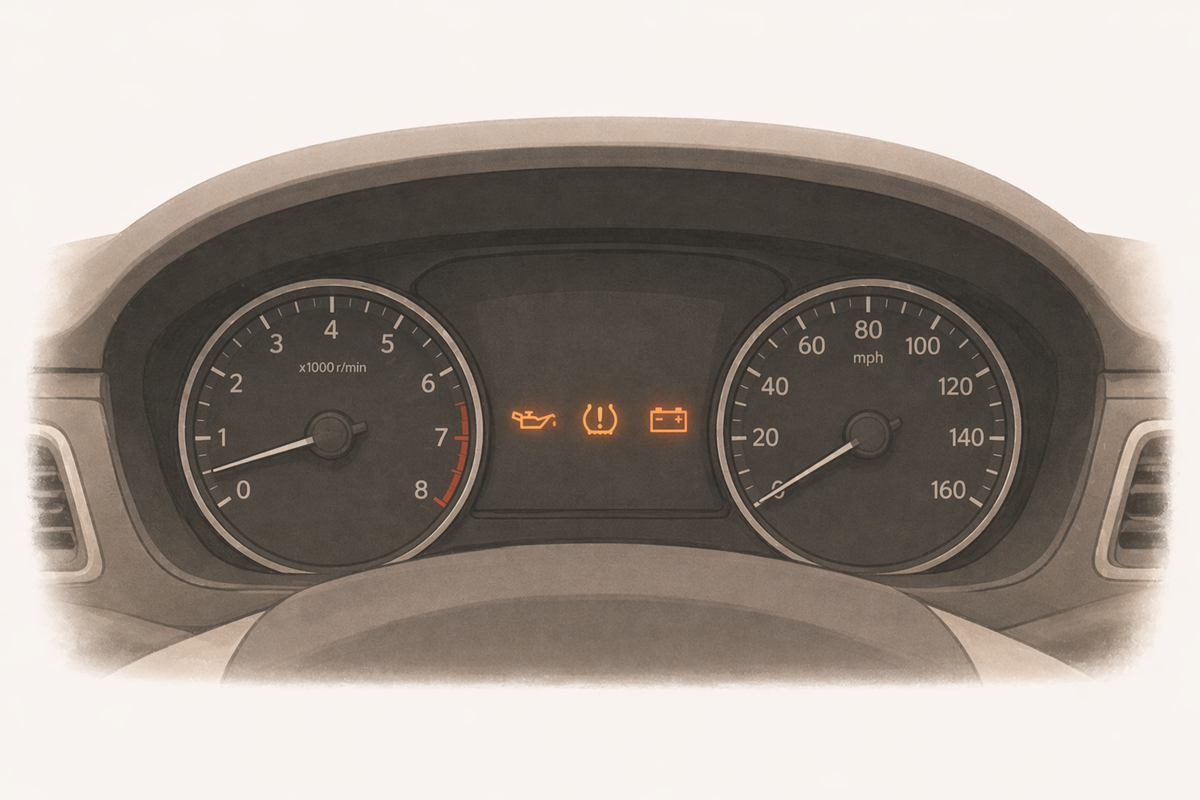
Warning lights. The two that matter most immediately: oil pressure and temperature. Oil pressure light on means stop driving when it's safe and check the oil. Temperature warning means the engine is overheating. Pull over and do not open the radiator cap. The check engine light covers a wide range. If it's solid, get it looked at. If it's flashing, get off the road soon. Teach them the difference between "handle today" and "handle now." A BlueDriver scanner reads the actual code, which turns a vague warning into a specific decision about whether the car is safe to keep driving.
What happens when you turn the key and nothing happens. There are two different situations here. A clicking sound usually means a dead battery. No sound at all often means something else: a bad connection, a blown fuse, or a starter issue. Neither is a reason to panic. Both are reasons to not keep cranking and call for help. Keep a set of Energizer 2-gauge cables in the trunk.
How to pop the hood and trunk. This sounds obvious. It is less obvious at 16 in a parking lot when something has gone wrong and someone is trying to help you.
Where the manual is. In the glove box. Put it there and tell them it's there. They won't read it. But they'll know to open it when something comes up that neither of you covered in the driveway.
The Rule After the Walkthrough
Once you've done the lesson, give them one standing rule: if something seems off, whether it's a sound, a light, or a feeling in the car, they call before they keep driving.
Not after they've gone another 20 miles. Not when they get home. Before. What to do once they've stopped is its own lesson.
I drove that Bonneville for months with a broken gas gauge, estimating fuel by mileage. Mostly fine. Then one day on the highway: not fine. The car didn't warn me because there was nothing left to report. Now I actually check things. It takes two minutes. It has saved me more than two minutes more than once.
One More Thing About the Manual
Google is great. YouTube is useful. But neither of them knows your specific car.
The manual that came with the vehicle tells you the correct oil type for that engine. The tire pressure spec for those tires. What that specific warning light means on that specific dashboard. The service intervals for that transmission, that engine, those belts.
You can find the manual online for any make, model, and year. It is not a thrilling document. But it is the most specific resource your teen has for the car they actually drive, and it costs nothing to open it.
There was a time when caring about something meant learning about it. The manual is a decent place to start that.
Try This
1. Do it in the driveway, not in a parking lot. Familiar environment, no pressure. Run through everything once before they drive alone.
2. Make it a walkthrough, not a lecture. Have them physically open the hood, pull the dipstick, press the tire gauge. Watching is not learning.
3. Go over the two warning lights that mean stop. Oil pressure and temperature. Everything else can wait. Those two cannot.
4. Do it again in six months. They'll remember more the second time, and the habit of checking starts to feel normal. When they're ready for something bigger, changing a tire is the natural next lesson.
The New Driver's Parent Checklist is a 4-page printable for parents teaching a teen to drive. Pre-drive checks, the four skill stages, and word-for-word scripts for the hard moments. Download it free →
Ten minutes in the driveway now is worth a lot more than a phone call from the side of a road later.
The basics are actually basic. That's the whole point.